Product Description
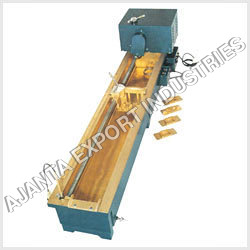
Bituminous surfaces exposed to varying temperature conditions undergo a great deal of expansion and contraction. Therefore, an important characteristic of the binder is its ductility and the degree of ductility has an effect on the cracking of bituminous surfaces caused by traffic stress. The ductility of bitumen is expressed as the distance in centimetres to which a standard briquette can be elongated before the thread thus formed breaks under specified conditions.A molten bitumen sample is poured into a standard mould, allowed to cool to room temperature and then placed in a water bath so that the briquette can be brought to test temperature before mounting in the testing machine.Designed to test three specimens simultaneously. The machine consists of a carriage moving over a lead screw. An electric motor driven reduction gear unit ensures smooth constant speed and continuous operation. The entire assembly is mounted with a stainless steel lined water bath completely encased in metal bound hardwood. It is equipped with an electric pump circulator and heater. The temperature is controlled thermostatically. Two rates of travel i.e. 5 cm/min and 1 cm/min are provided. Suitable for operation on 230 V, 50 Hz, Single Phase, A.C. supply. High-Precision Ductility TestingThis machine ensures accurate and repeatable tests for the deformation characteristics of bituminous materials, essential in quality assurance for road construction and pavement industries. With temperature and speed controls, it meets stringent international testing standards, delivering dependable results in laboratory environments.
User-Friendly Operation and VersatilityChoose between manual and automatic models to suit your testing workflow. The digital or analog display types facilitate straightforward readings, while the standard three moulds add testing versatility. Its corrosion-resistant stainless steel bath prolongs operational life, making it well-suited for ongoing laboratory use.
FAQ's of Ductility Testing Machine:
Q: How does the ductility testing machine measure bituminous material elongation?
A: The machine evaluates the ductility of bituminous materials by stretching a test specimen, prepared in a standard mould, at a uniform speed of 50 mm/min in a temperature-controlled stainless steel bath set up to 27C. It records the extension length until the sample breaks, displaying the value either digitally or via an analog indicator.
Q: What standards does the ductility testing machine comply with?
A: This apparatus is designed to comply with IS 1208, ASTM D113, and BS 2000 standards, ensuring that test results are accepted and recognized globally for quality control in bituminous material applications.
Q: When should a laboratory opt for the manual versus the automatic model?
A: The choice depends on sample throughput and workflow preferences. Manual models suit smaller test volumes and provide hands-on control, while automatic models are ideal for high-throughput labs seeking efficiency and reduced operator intervention.
Q: Where is the ductility testing machine typically used?
A: This machine is primarily utilized in laboratory settings within civil engineering, road construction, and bitumen manufacturing industries for quality control and research purposes, verifying the material's deformation capabilities under specified conditions.
Q: What is the process for setting up a ductility test using this machine?
A: Prepare bituminous samples in the supplied standard moulds, submerge them in the stainless steel bath set to the required test temperature, and initiate stretching at the set speed. The elongation at break is then measured and recorded using the provided display system.
Q: What are the benefits of using this ductility testing machine?
A: The instrument provides precise, reliable testing of bitumen ductility, which is vital for assessing material suitability in road construction. Its compliance with international standards, temperature stability, and robust construction ensure consistent results and long-term usability.







 English
 Spanish
 French
 German
 Italian
 Chinese (Simplified)
 Japanese
 Korean
 Arabic
 Portuguese



 Send Inquiry

