Product Description
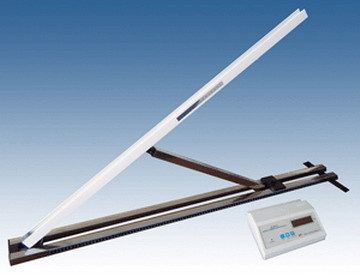
MAGNETIC DAMPING AND COEFFICIENT OF KINETIC FRICTION TESTING LABORATORY APPARATUS
Description:
Magnetic damping is an important conception of electromagnetism and widely applying on every physics field, but it is seldom to directly be measured. With advanced integrated Hall sensor (hereinafter Hall switch for short), magnetic damping and coefficient of kinetic friction testing laboratory apparatus is capable of measuring down-slide velocity of magnetic slider on a no ferromagnetic good conductor inclined plane, and meanwhile finding out magnetic damping and coefficient of kinetic friction after data processing. With Hall switch, the apparatus also can capable of measuring time and converting the nonlinear equation into linear one by means of a clever data processing method. This is a comprehensive physics experiment, with which the students ability will be trained.
The apparatus has following advantages:
1. Reliable design and easy angle adjustment of the device;
2. Good repeatability and consistency of experimental data and less experimental error;
3. Intellectualized timer can save the timing data for 10 times for looking up.
EXPERIMENTS:
Magnetic damping and coefficient of kinetic friction testing.
Details:
| Adjustable angle range of inclined guide rail: | 0~45 |
| Length of inclined guide rail: | 440mm |
| Adjustable support: | 630mm |
| Intellectualized timer: | Timing frequency (memory): 10 times (0-9) Timing range: 0.000-9.999s Timing resolution: 0.001s |
| Magnetic slider: | 18mm in diameter, 6mm in thickness and 11.07mg of mass. |
Precision Meets PracticalityDesigned for accurate measurement of magnetic damping and kinetic friction, this apparatus features a durable, laser-engraved scale and a polished friction surface. The interchangeable sliders-some with powerful magnets-allow students to easily explore physics principles in a controlled and reliable environment.
Built for Laboratory ExcellenceSuitable for undergraduate and postgraduate curricula, the apparatus utilizes high-quality materials such as mild steel, aluminium, and acrylic. Its sturdy, portable construction ensures years of reliable usage. With no need for electricity or special maintenance, it provides a convenient, hands-on experience.
Versatile and User-FriendlyOffering manual operation with a simple slide-and-release mechanism, this equipment empowers experimenters to control initiation speed and process. The clearly marked scale and visible magnet setup facilitate straightforward data collection and concept visualization, supporting diverse laboratory applications.
FAQ's of MAGNETIC DAMPING AND COEFFICIENT OF KINETIC FRICTION TESTING LABORATORY APPARATUS:
Q: How is the Magnetic Damping and Coefficient of Kinetic Friction Testing Apparatus used in the laboratory?
A: Simply place the desired aluminium slider-either with or without embedded magnets-onto the polished acrylic or metal track. Use the manual sliding or release mechanism to initiate motion. The laser-engraved scale allows for precise measurement of displacement, enabling thorough investigation of both magnetic damping effects and kinetic friction coefficients.
Q: What components are included with the apparatus?
A: The set comes with multiple interchangeable sliders (some with magnetic inserts), an instruction manual, a durable powder-coated track assembly with a graduated scale, and foam-protected packaging. No additional power supply or digital components are required, making it straightforward to set up and use.
Q: When is this apparatus most beneficial for educational use?
A: This device is designed for undergraduate and postgraduate physics laboratory courses. It aids students in hands-on exploration of key concepts such as magnetic damping and friction, supporting curriculum requirements throughout the academic year.
Q: Where is this apparatus primarily applied?
A: It is intended for use in physics departments of educational institutions, research laboratories, and training centers where experimental measurement of magnetic damping and friction is required.
Q: What is the process for measuring the coefficient of kinetic friction and magnetic damping?
A: Select and place a slider on the track, then manually slide or release it. Measure the displacement using the laser-engraved scale and compare results with and without magnetic inserts. Analysis of motion and stopping distance enables precise calculation of kinetic friction and demonstration of magnetic damping effects.
Q: How easy is the apparatus to maintain and store?
A: Simple maintenance is required-just wipe clean with a dry cloth. The corrosion-resistant construction ensures longevity, and the lightweight, tabletop design with detachable components allows for easy storage when not in use.
Q: What benefits does this apparatus offer to experimenters?
A: Students and instructors benefit from consistent, accurate results, clear visibility of magnetic arrangements, and user-friendly manual operation. The apparatus enhances conceptual understanding through direct interaction, with no need for external power or complex setup.







 English
 Spanish
 French
 German
 Italian
 Chinese (Simplified)
 Japanese
 Korean
 Arabic
 Portuguese


 Send Inquiry

